
Product
 Product
Five stages from legacy code to proven pipelines
Data migration is solved. Logic migration is not. Novuz is software, not a services team: your engineers run the same five stages on every estate, inside your environment, and each stage produces an output they review before anything moves forward. Agents can run Novuz, and agents can run what Novuz builds.
Self-service platform
Your team runs it. Not a consulting project.
Your engineers run Novuz and set the pace, the scope and the sign-off. The resolver handles the edge cases rules cannot settle, and an engineer approves every proposal. Novuz engineers stand behind every engagement, so your team is never on its own.
Step 1
Install in your environment
Pull the Novuz container or VM into your cloud account or data center. No outbound connection is required.
Step 2
Point it at your code
Connect your DDL, procedures and ETL. Discovery and conversion run on their own.
Step 3
Review the evidence
The resolver proposes fixes for edge cases. Your engineers approve every proposal and sign off on each reconciliation report.
Step 4
Deploy when ready
Ship validated pipelines to your target platform on your schedule.
Discovery runs first: every object counted, dead code flagged before any conversion starts.
Stage 1
Discover: know exactly what you have
Novuz parses every schema, procedure, package, script and schedule in scope. It builds a model of how objects depend on each other and where data flows. Each object gets a complexity band. The output is a Discovery report: a workbook with a warehouse summary, an ETL summary and a line per object. This is the work teams usually do by hand in spreadsheets. Here it is a by-product of the conversion.
- Full object inventory by type and source
- Lineage and dependency map, upstream and downstream
- Complexity band per object, used for scope and price
- Dead code and unused objects flagged
- Discovery report you can share with your platform team and your auditor


Stage 2
Converge: deterministic conversion
The engine converts each object using fixed, versioned rules, selected by inference over the object’s patterns, with a confidence score at every decision. It maps legacy SQL dialects, control flow and package logic to code that runs natively on your target. The same input gives the same output on every run. There are no prompts, no sampling and no model cost at this step. About 95% of objects finish here.
- Repeatable output you can diff between runs
- Readable target code that follows your naming standards
- No external model calls during conversion
- Confidence score on every decision
Stage 3
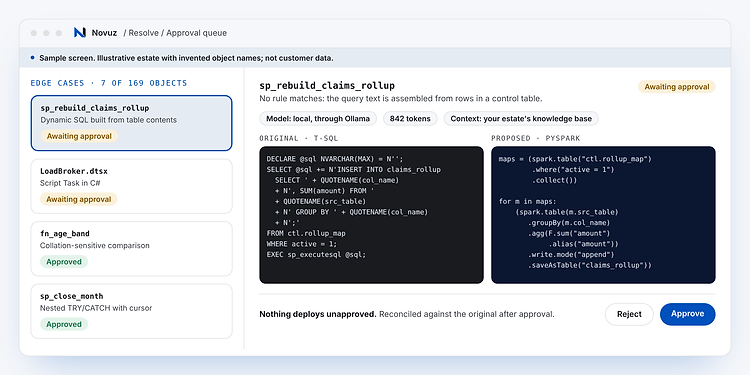
Resolve: edge cases, handled in context
Some objects use patterns that rules cannot settle alone. Novuz sends these to a resolver. The resolver draws on a knowledge base built from your own estate and kept inside your environment. It proposes a fix at 700 to 1,000 tokens per edge case. An engineer reviews and approves every proposal. Nothing deploys unapproved.
- Runs on a model you approve: Claude or Gemini under your own agreement, or a local model through Ollama with no external calls. If you choose a hosted model, only the edge-case fragments go to it
- Every resolved object has a human sign-off
- Knowledge base never shared across customers

Stage 4
Validate: a reconciliation report for every object
Every converted object is checked against the original. Novuz compares schemas, row counts and column-level values on the same input data. Each object gets a reconciliation report showing what matched and what did not. These reports are what you show your auditor and your business owners.
- Schema, row count and value-level checks
- Pass, fail or review status per object
- Exportable evidence for audit and sign-off


Stage 5
Deploy: production pipelines inside your perimeter
Validated code is deployed to your target with orchestration rebuilt to match the original schedule and dependencies, and the running system is replicated there. Code assistants hand back files; Novuz deploys and replicates. Novuz runs as a container or VM in your cloud account or data center, and no outbound connection is required.
- Orchestration rebuilt with the original dependencies
- Converted code is native to your target, with no Novuz runtime in it
- Docker or VM deployment in your environment
- Supports a parallel run before cutover
- The delivered pipelines can be exposed as MCP tools your agents call
Coverage
What Novuz converts, by source
Sources: SQL Server (T-SQL), SSIS, Teradata including BTEQ, Hadoop (Hive, Impala) and Snowflake. Targets: Databricks, Microsoft Fabric, Snowflake, Apache Iceberg and Delta Lake. Not today: Oracle, mainframe, Informatica, DataStage, Netezza and Redshift. Coverage is confirmed per estate during the assessment.
| Object type | SQL Server | SSIS | Teradata | Hadoop (Hive, Impala) | Snowflake |
|---|---|---|---|---|---|
| Schemas and tables | Yes | n/a | Yes | Yes | Yes |
| Views | Yes | n/a | Yes | Yes | Yes |
| Functions | Yes | n/a | Yes | Yes | Yes |
| Stored procedures / macros | Yes | n/a | Yes | n/a | Yes |
| Scripts (BTEQ, HiveQL) | n/a | n/a | Yes | Yes | n/a |
| ETL packages and data flows | n/a | Yes | n/a | n/a | n/a |
| Orchestration and schedules | Yes | Yes | Yes | Yes | Yes |
| Data migration | Yes | n/a | Yes | Yes | Yes |
Walkthrough
See a conversion from start to finish
A short walkthrough of one estate going through all five stages, from inventory to reconciliation report.
Why deterministic
Why deterministic conversion
There are three common ways to convert legacy logic. They differ in what you can prove afterwards.
| Manual rewrite | Probabilistic (LLM-only) conversion | Deterministic conversion (Novuz) | |
|---|---|---|---|
| Same input, same output | No | No | Yes |
| Elapsed time | Months to years | Quick to draft, slow to prove | Typically 4 to 8 weeks on 1,000 to 1,600 objects |
| Explains each change | Depends on the engineer | Rarely | Yes, rule by rule |
| Evidence per object | Manual testing | Manual testing | Reconciliation report |
| Cost driver | Engineer hours | Open-ended tokens and rework | Fixed price per scope, set before work starts |
| Code leaves your environment | Depends on vendor | Often | No |
| Deploys and replicates the running system | Depends on the team | No; hands back files | Yes |
Novuz converts by fixed, versioned rules. A language model is used only at the edge, by the resolver, with an engineer approving every proposal, because auditors do not accept probabilities.
Agentically primed
 Agentically primed
Agents can run Novuz. Agents can run what Novuz builds.
Both the Novuz platform and the pipelines it delivers can be run by agents: the platform through its APIs, the pipelines through MCP. The conversion itself stays deterministic.
The platform is headless
Everything Novuz does through its UI it also does through APIs. Your orchestrator, your CI/CD pipeline, your SI’s tooling or an AI agent can trigger discovery, conversion, validation and deployment, inspect results, and gate the next step on a human approval.
The pipelines are MCP-ready
Through the Model Context Protocol, each converted pipeline can expose run, check status, retrieve lineage, inspect outputs and rerun a failed step as tools your agents discover and call, under your access, approvals and audit logging, on Databricks, Snowflake or Microsoft Fabric.
What stays the same: the conversion is deterministic. Agents decide what to ask for and when; the platform gives the same output for the same input, so every result can be tested, audited and repeated.
| Headless platform | MCP-ready pipelines | |
|---|---|---|
| Applies to | The Novuz modernization engine | The pipelines Novuz delivers |
| Used by | Delivery teams, partners, orchestrators, agents | Operations and data agents, downstream applications |
| Purpose | Run modernization programmatically and continuously | Run and manage the modernized estate through agents |
| Outcome | Faster, repeatable migration | Pipelines that are agent-ready from day one |
An agent gets only what you expose, under your own access, approvals and audit logging.
Honest fit
Who should not choose Novuz
Novuz is not the right choice for estates under about 300 objects; for Oracle-only or mainframe estates; for teams with no target and no date inside 18 months; for buyers who want staff augmentation rather than software; or for organizations that cannot run software inside their environment or share code for an assessment.
FAQ
Frequently asked questions
Last reviewed:
Find out what your logic debt is costing you.
Every object counted, lineage, dead code and a fixed price in three business days. $3,000, credited.
Not sure which door? The scorecard takes ten minutes and tells you.