Most of the current enterprise modernization efforts happen in siloes. Piecemeal modernization breaks the critical dependencies of enterprise workflows, in terms of data, applications, business logic. A comprehensive reengineering approach is what it takes to gain the targeted outcomes and ROI from expensive modernization projects.
Why Modernization Efforts Break Down: The Paradox of Piecemeal Modernization
Most enterprise modernization initiatives fail not because of technology limitations, but because of how the migration is approached.
A common approach is based on moving pieces of a system (e.g. tables, workflows, data, reports) in siloes. While this appears to have lower risk on the surface, it fundamentally misunderstands how tightly coupled enterprise data ecosystems are.
Ultimately, incomplete modernization as broken strings of disconnected systems at various levels of legacy vs modern techstacks, fails because it treats systems as loose components.
Successful modernization treats them as systems of intent. Full-system replication via a digital twin ensures that nothing is lost in translation. This approach transforms modernization from a risky, labor-intensive exercise into a predictable, engineering-driven process.
The current state of legacy data estates:
The legacy data warehouse is not just a collection of tables. It is an interconnected system of workflows:
When migration happens in fragments, these elements are notfully captured or reassembled, resulting in:
Ultimately, organizations end up in a paradox: they’ve “migrated” but are far from production-ready. Different parts of the systems function at different levels of maturity and modernity. Naturally, from speed, performance, cost and quality standpoints, they are working out of sync.
As a result, the targeted outcomes and ROI metrics from these siloed modernization projects are seldom achieved. Then, these failing migration initiatives are followed by a prolonged stabilization phase filled with rework, debugging, and patching, driving cost overruns and delays. Overall it becomes aspiraling struggle and trade-off between cost, complexity, utility and performance.
Plan for a comprehensive reengineering approach via full-systemreplication
The solution to a siloed failing initiative is to have an integrated, end-to-end, strategic approach with a comprehensive reengineering roadmap and full-system replication initiatives. This proposed solution flips the paradigm of piecemeal migration to holistic system replication.
At the center of this approach is the concept of a digital twin: A functionally equivalent, fully reconstructed version of the legacy system in the modern environment. This is not a lift-and-shift. It is a deep reengineering process that ensures the following are faithfully replicated:
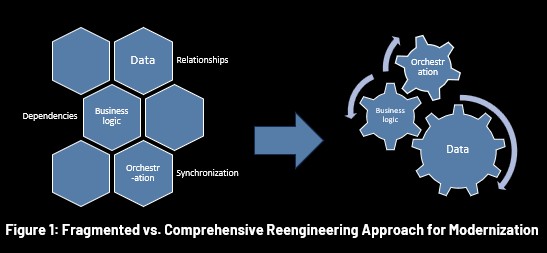
Think of the modernization program like the transmission system in a vehicle, where all the data systems and enterprise applications with their data structure and business logic layers need to work in perfect orchestration. By replicating the entire system as a cohesive unit, the digitaltwin approach eliminates what can be called semantic drift - the gradual lossof meaning and behavior during migration. Instead of reconstructing intentmanually after migration, intent is preserved by design.
The outcomes are strategic success factors instead offailure points triggering multiple isolated project threads. The results showup in:
A media analytics company: Snowflake to Databricks migration
A leading B2B legal intelligence platform: Snowflake to Databricks migration
A $2B Supply chain unicorn startup: SQL Server to DeltaLake migration